Mastering basic planks builds a solid foundation, but adding advanced variations challenges your core muscles more deeply. These advanced plank variations improve stability, coordination and muscle activation beyond what a standard plank can offer. By removing support points or introducing movement, you force your body to work harder and recruit more core fibers.
Advanced plank variations are ideal for those who already perform standard planks with good form. They elevate the demand on balance and strength, increasing the effectiveness of your core training.
Whether your goal is strength, endurance or functional fitness, incorporating these plank variations helps you push beyond basic holds and develop a more resilient, powerful midsection.
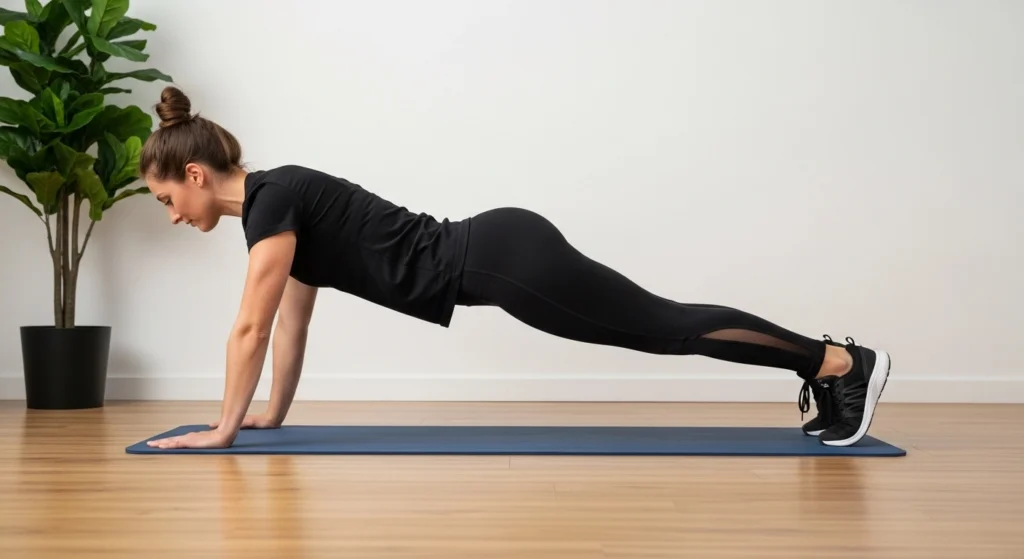
Alternating leg lift plank
In this variation, you perform a regular plank but lift one leg at a time. Raising a leg removes a point of contact and forces your core to stabilize against rotation and imbalance. This intensifies the demand on your abdominal muscles and glutes.
Lateral plank walk
The lateral plank walk involves moving your body sideways while maintaining a stable plank position. This variation challenges not only the core but also shoulders and upper body stability. It requires control and coordination, making the muscles work harder.
Unstable support plank
Using an unstable surface, such as a balance disc or Bosu ball, increases neuromuscular demand. The instability forces deeper core stabilizers to engage continually to maintain alignment. This advanced variation enhances balance and proprioception.
Shoulder touch plank
In this variation, you alternate touching each shoulder with the opposite hand while holding a plank. The movement forces the body to resist torso rotation, placing greater emphasis on the obliques and deep abdominal stabilizers. It’s an excellent progression for those seeking more dynamic core challenge.
Plank with external load
Adding external weight — such as a weighted vest or plates on your back — transforms a static plank into a strength challenge. This variation increases isometric load on the core muscles while requiring perfect alignment. Always ensure technique remains solid, as added weight elevates difficulty.
When to advance your plank training
These advanced variations are best introduced after you can perform standard planks with perfect form and alignment. Quality of execution matters more than duration or difficulty, so focus on controlled movement before increasing challenge.
Conclusion
Advanced plank variations take your core training to the next level by increasing instability, movement complexity and strength demand. From leg lifts and lateral walks to unstable surfaces and added load, these modifications strengthen deep stabilizers and enhance overall fitness. Use them as part of a balanced routine to improve core strength, stability and performance.

Hello! My name is Alan Teixeira and I am passionate about helping people live healthier, more balanced lives. From mindful eating to daily habits that promote physical and mental well-being, I believe that small, consistent changes can lead to powerful transformations.
I created this blog to share practical tips, reliable information, and thoughtful insights that can inspire you to take better care of yourself—with balance, mindfulness, and positivity.
If you are looking to improve your health, nourish your body, and build a lighter, more fulfilling routine, you are in the right place. Welcome!